Understanding The Difference Between AI Security Assurance and AI Governance
HITRUST AI Security vs. ISO 42001
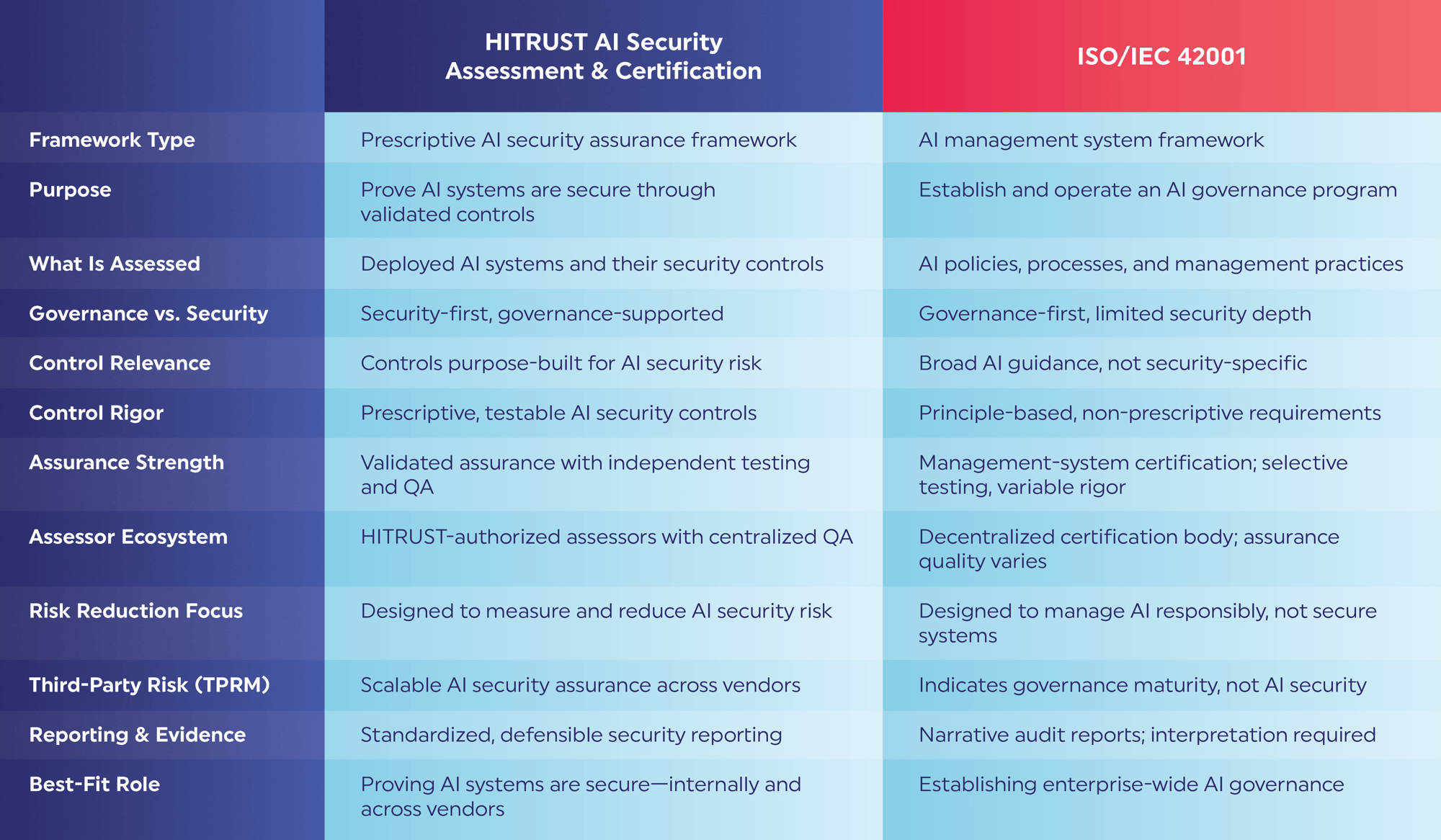
As AI adoption accelerates, organizations are increasingly evaluating different approaches to managing AI risk, such as the HITRUST AI Security Assessment and Certification and ISO/IEC 42001. While both play important roles, they are designed for fundamentally different outcomes.
HITRUST focuses on proving whether AI systems are secure. ISO/IEC 42001 focuses on how AI is governed. Understanding this distinction is essential as AI becomes operational, embedded in products, and introduced through third parties.

AI risk no longer stops at the enterprise perimeter. It now exists inside third-party software, platforms, and services that organizations rely on every day. As vendors rapidly introduce AI-driven capabilities, organizations must assess not just governance intent, but the actual security of AI systems in use.
HITRUST AI Security Assessment and Certification was developed to deliver validated, prescriptive AI security assurance for real-world AI environments. It evaluates whether AI security controls are implemented, tested, and effective — producing evidence-based confidence.
ISO/IEC 42001 helps demonstrate AI governance maturity, including policies, accountability, and oversight, through an AI management system. While security is addressed at a management-system level, the standard is not designed to deeply validate the technical security of deployed AI systems.
As AI becomes embedded across vendor ecosystems, organizations need more than governance signals. They need defensible, measurable AI security assurance that scales across third parties and reduces risk.