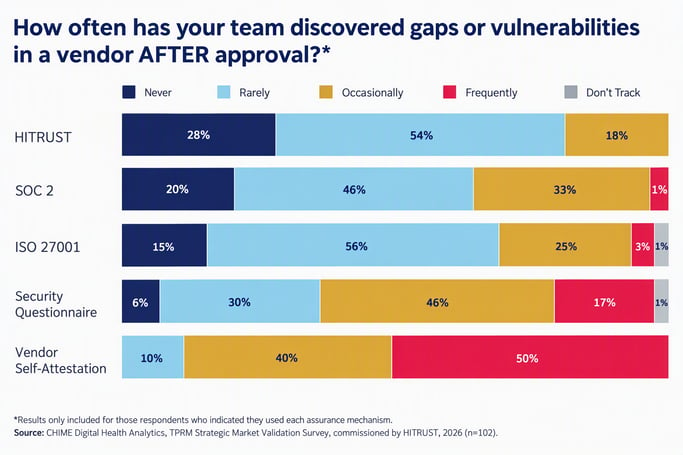
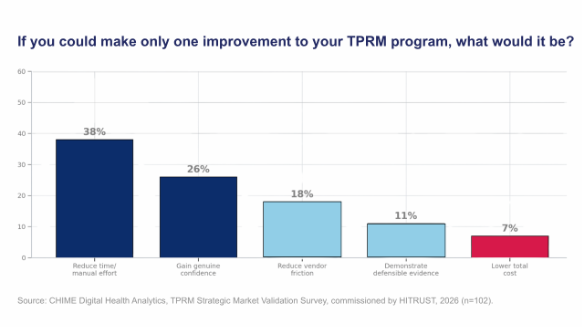
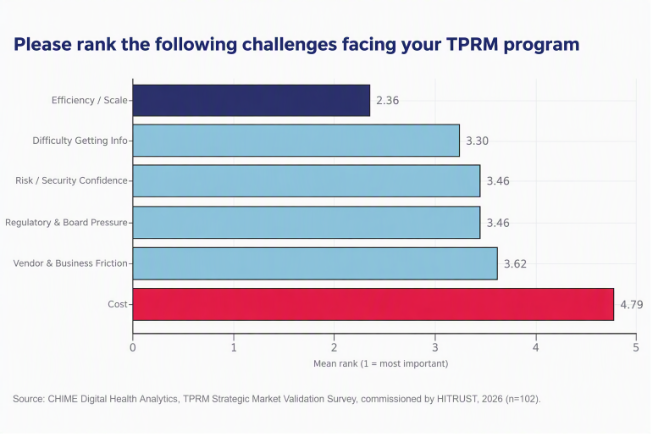
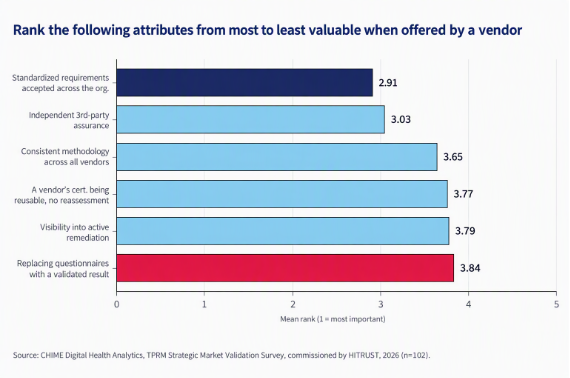
Join HITRUST and Sidekick Security for our pivotal webinar to explore why Third-Party Risk Management (TPRM) strategies often fail despite heightened focus and investment. This session will dissect systemic flaws, like reliance on static security questionnaires and inconsistent risk assessments, that prevent effective third-party risk management across industries. We will discuss the need for a paradigm shift towards proactive, innovative, and integrated TPRM strategies that align compliance with real-world threat mitigation. Learn how to advance beyond conventional methods to adopt dynamic, scalable solutions for a resilient third-party risk framework.
If you liked this webinar, you may also be interested in:
Jan 14, 2026
AI security risk is escalating faster than organizations can measure it. AI governance frameworks such as ISO/IEC 42001 establish oversight and accountability, but they do not evaluate the security of AI systems. As AI becomes embedded in products, services, and vendor ecosystems, validated AI security assurance offers a stronger, more practical way to measure and reduce real AI risk, where governance alone falls short.
What is the difference between AI governance and AI security?
AI governance defines how AI is managed within an organization. It focuses on policies, decision-making structures, roles, and oversight intended to ensure responsible and compliant AI use.
AI security focuses on how AI systems are protected. It examines whether controls are implemented in deployed systems, whether they are tested, and whether they actually work.
Governance sets expectations. Security assurance validates reality.
Why AI security risk remains largely invisible in TPRM
AI is being deployed at a pace that outstrips traditional risk management models. Vendors are introducing AI capabilities continuously, often without clear visibility into how those systems are secured or monitored.
Most third-party risk programs still rely on indirect signals such as questionnaires and attestations to assess vendor security.
With AI, this approach breaks down. Risk teams are left to infer security posture from narrative evidence, while the actual AI systems remain untested. Because AI security controls are selectively tested and rarely validated, organizations often do not know what protections are actually in place until an incident occurs. This creates a false sense of control, where risk appears managed on paper but remains unmeasured in practice.
Why governance frameworks cannot reduce AI security risk
Governance frameworks are designed to manage behavior, not validate technical outcomes.
They do not
- Prescriptively define AI security controls
- Require testing of deployed AI environments
- Validate control effectiveness through independent assessment
- Provide standardized, comparable evidence of AI security
For instance, ISO/IEC 42001 is a governance framework designed to help organizations establish an AI Management System (AIMS). It provides structure around accountability, documentation, and continuous improvement for AI activities. However, ISO/IEC 42001 does not deeply assess the security of AI systems that are deployed and in use. Controls may be selectively implemented and selectively tested by accredited as well as unaccredited certification bodies, resulting in inconsistent assurance strength.
How AI security assurance delivers stronger risk reduction
AI security assurance focuses on measurable outcomes.
Rather than evaluating intent, it validates whether security controls are implemented, tested, and effective in real AI systems. This provides clear evidence that AI-related threats are being addressed.
Unlike management system audits, effective AI security assurance requires that all applicable controls be tested, using consistent methods and rigor through authorized assessors, so results can be relied upon by regulators, customers, and third-party risk teams.
The HITRUST AI Security Assessment and Certification was built specifically to deliver this level of assurance.
How HITRUST AI compares to ISO/IEC 42001
|
Category |
HITRUST AI Security Assessment and Certification |
ISO/IEC 42001 |
|
Primary objective |
Prove AI systems are secure |
Establish AI governance |
|
What is evaluated |
Deployed AI systems and security controls |
AI management processes |
|
Control approach |
Prescriptive, AI-specific, risk-based |
Principle-based governance |
|
Validation method |
Independent testing and centralized QA |
Management system audits with selective testing |
|
Evidence provided |
Standardized, defensible security assurance |
Governance conformance evidence |
|
Ability to reduce AI security risk |
High |
Limited by design |
For a detailed comparison between HITRUST AI Security Assessment and Certification and ISO/IEC 42001, read our recent blog post.
Why HITRUST offers what governance frameworks cannot
HITRUST is the only reliable solution built for AI security assurance. HITRUST AI Security Certification provides organizations with something governance frameworks are not designed to deliver: trusted proof of AI system security.
It is
- Fast, enabling timely response to emerging AI threats
- Focused, targeting real AI security risks in deployed systems
- Affordable, allowing assurance to scale across vendors and internal environments
This makes AI security assurance practical, actionable, and repeatable.
HITRUST also delivers consistent assurance through vetted assessors, prescriptive, threat-driven testing requirements, and centralized quality assurance, reducing the variability and interpretation risk common in governance-based certifications.
What this means for organizations managing AI risk
AI governance establishes expectations. AI security assurance establishes trust.
As AI continues to permeate vendor ecosystems, organizations cannot rely on oversight alone. They must be able to measure security directly and act on verified results.
The organizations that move first will not just respond to AI risk — they will control it.
Why is AI Security Assurance More Effective than AI Governance Frameworks? Why is AI Security Assurance More Effective than AI Governance Frameworks?
Jan 7, 2026
ISO/IEC 42001 and the HITRUST AI Security Assessment and Certification address AI risk from fundamentally different angles. While ISO/IEC 42001 defines how organizations govern AI, HITRUST provides assurance that AI security controls are implemented and tested, producing evidence-based confidence in the security of deployed AI systems.
Why organizations must focus on AI security now?
AI adoption has accelerated faster than most security and risk programs can adapt. AI risk no longer stops at the enterprise perimeter. It now lives inside the software, platforms, and services organizations buy and rely on every day.
Vendors are racing to introduce AI features and back-office efficiencies, often faster than security teams can assess them. For third-party risk management (TPRM) teams, this creates a critical question: How do we know a vendor’s AI platform is secure?
That question drives direct comparisons between ISO/IEC 42001 and the HITRUST AI Security Assessment and Certification.
What problem does ISO/IEC 42001 solve?
ISO/IEC 42001 demonstrates that an organization has implemented an AI governance and management structure. It shows that policies exist, responsibilities are defined, and AI-related activities are overseen through a formal management system.
For vendor risk programs, this can signal
- Governance maturity
- Executive oversight of AI
- Commitment to responsible AI practices
ISO/IEC 42001 certification is based on whether the AI management system meets the standard’s requirements, but audits are typically risk-based and sample evidence rather than testing every possible control in depth. As a result, some listed controls may never be tested, even in certified environments.
In the market, ISO/IEC 42001 certifications may be issued by either accredited certification bodies (preferred) or non-accredited bodies. Accreditation improves consistency and trust, but buyers may not always be able to easily distinguish the rigor behind different certificates. This creates a market where assurance rigor varies significantly. TPRM teams cannot easily distinguish high-quality audits from low-quality ones.
Overall, ISO/IEC 42001 is not primarily designed as a technical security validation of a deployed AI system; it validates the organization’s AI management systems and governance processes, with security addressed through management-system controls rather than deep system testing. It answers how AI is managed — not how AI is protected.
What problem does HITRUST AI Security Certification solve?
The HITRUST AI Security Assessment and Certification addresses a different and increasingly urgent problem: proving that deployed AI systems are secure.
HITRUST focuses on
- AI-specific security risks in real systems
- Prescriptive controls mapped to threats and tailored to AI deployment scenarios
- Independent testing, centralized quality assurance, and certification
Rather than evaluating governance maturity, HITRUST validates whether security controls are implemented, tested, and effective in operational AI environments. Every applicable HITRUST AI security control must be implemented and tested for certification. There is no selective control adoption or selective testing. This delivers defensible, evidence-based AI security assurance.
How do ISO/IEC 42001 and HITRUST AI compare?
|
Category |
HITRUST AI Security Assessment and Certification |
ISO/IEC 42001 |
|
Purpose |
AI security assurance: proves AI systems are secured through validated controls |
AI governance framework: establishes an AI Management System (AIMS) |
|
Framework type |
Prescriptive security assurance framework purpose-built for AI risk |
Management system framework focused on governance, policy, and oversight |
|
What is assessed |
Deployed AI systems and the security controls protecting them |
Organizational AI management processes and controls |
|
Governance vs. security |
Security-first with measurable, testable outcomes |
Governance-first; security depth is limited by design |
|
Control rigor |
AI-specific, prescriptive controls mapped to threats and tailored by deployment scenario |
Largely non-prescriptive, principle-based requirements extending far beyond security |
|
Assurance strength |
Independent testing, centralized QA, and HITRUST certification |
Management-system certification, selective testing; assurance varies by certification body |
|
Best-fit for |
Proving AI systems are secure, internally and across vendors |
Establishing enterprise-wide AI governance and accountability |
Why governance alone doesn’t reduce AI security risk
Governance maturity does not equal security assurance.
Two organizations may both hold ISO/IEC 42001 certifications while operating AI systems with vastly different security postures. Because the standard is principle-based, security depth depends heavily on interpretation and implementation.
For TPRM teams, this creates
- Inconsistent evidence across vendors
- Heavy reliance on narrative explanations
- Increased effort to interpret and normalize risk
When AI is embedded in third-party products, this lack of standardization leaves material security risk unmeasured.
How HITRUST delivers measurable AI security assurance
HITRUST AI Security Certification was developed through extensive industry collaboration to address this exact gap. It enables scalable trust across vendor ecosystems by providing
- 44 harmonized, AI-specific security controls
- Prescriptive controls mapped to NIST publications, ISO/IEC standards, and OWASP guidance
- Regular updates to address emerging AI threats
- Explicit mapping between threats and required controls
- Standardized reporting suitable for executives, regulators, and TPRM teams
The outcome is proof that AI systems are protected.
Is ISO/IEC 42001 or HITRUST AI the right choice?
For most organizations, the answer is not one or the other. It is understanding their distinct roles.
- ISO/IEC 42001 helps organizations govern AI responsibly.
- HITRUST AI Security Certification helps organizations prove AI systems are secure.
When AI is operational, customer-facing, or embedded in third-party products, governance alone is not enough.
In our upcoming blog, we’ll explore why this creates a critical blind spot in third-party risk management and why validated AI security assurance is becoming essential for managing AI risk at scale.
ISO/IEC 42001 vs. HITRUST AI: What’s the Difference? ISO/IEC 42001 vs. HITRUST AI: What’s the Difference?
Dec 29, 2025
HITRUST transforms cybersecurity in third-party risk management from a costly compliance burden into a scalable, defensible, and resilient business advantage. Organizations using the HITRUST validated assurance model report higher efficiency, lower operational costs, and dramatically improved risk posture — achieving measurable results that prove trust can be both strategic and profitable.
In our previous post, we explored what validated assurance is and how HITRUST operationalizes it. Now, let’s look at the outcomes, the tangible business impact of turning reactive vendor oversight into validated, proactive assurance.
How does HITRUST improve TPRM efficiency?
Traditional TPRM programs rely on repetitive, manual reviews that slow down procurement and exhaust risk teams. HITRUST replaces this fragmented approach with a standardized, reusable, and scalable model.
Efficiency gains include
- 3–5× higher vendor assessment throughput by standardizing methods and automating evidence reuse.
- Faster onboarding cycles, as pre-validated vendors can be approved in a fraction of the time.
- Streamlined collaboration across procurement, compliance, and security teams using consistent data and shared assurance results.
With the HITRUST validated assurance, every vendor review adds value, not administrative overhead.
How does HITRUST reduce TPRM operational costs?
Manual risk reviews consume valuable time, personnel, and budget. By eliminating redundant assessments and reusing validated certifications, organizations achieve up to 50% lower TPRM operational costs.
Key cost drivers reduced
- Labor hours spent managing questionnaires and evidence reviews.
- Redundant vendor assessments across departments.
- Inefficient coordination between buyers and vendors.
HITRUST consolidates assurance efforts into a single, defensible framework, reducing both cost and complexity while improving visibility.
How does HITRUST strengthen resilience and risk confidence?
Efficiency and cost savings are just the beginning. The true power of validated assurance lies in resilience. According to the HITRUST 2025 Trust Report, 99.41% of HITRUST-certified environments remained breach-free in 2024. That’s not a coincidence. It’s proof that verified, continuously updated controls lead to measurable protection.
Validated assurance improves resilience through
- Evidence-based security: Every certification is independently verified and quality-controlled.
- Continuous improvement: Threat-adaptive updates ensure controls evolve with emerging risks.
- Transparent results: Organizations gain clear visibility across vendor ecosystems to spot weaknesses before they become threats.
The outcome: fewer incidents, faster response times, and greater confidence across the supply chain.
How does HITRUST turn risk management into a strategic advantage?
Validated assurance doesn’t just prevent problems. It accelerates opportunity. By reducing friction between vendors and assessing organizations, HITRUST transforms third-party risk management into a business enabler.
With HITRUST validated assurance
- Vendors gain credibility through verified certifications recognized across industries.
- Organizations streamline procurement and strengthen compliance defensibility.
- Boards and regulators receive transparent, comparable, and auditable assurance data.
This shared trust ecosystem empowers organizations to move faster, innovate confidently, and demonstrate leadership in security and compliance.
What’s the bottom line?
HITRUST offers a proven model driving measurable business outcomes for cybersecurity in TPRM.
|
Business Challenges |
HITRUST Impact |
|
Vendor review bottlenecks |
3–5× faster vendor throughput |
|
Rising TPRM costs |
Up to 50% operational cost reduction |
|
Vendor risk uncertainty |
99.41% breach-free certified environments |
|
Reactive oversight |
Proactive, defensible assurance |
|
Compliance fatigue |
Streamlined, scalable trust ecosystem |
What was once a reactive process of vendor oversight has become a strategic pillar of resilience and growth, all made possible through HITRUST’s validated assurance ecosystem.
Learn more in our white paper
Explore how validated assurance delivers measurable efficiency, risk reduction, and resilience in our new white paper: Redefining Third-Party Risk Management with the HITRUST Validated Assurance
Discover how HITRUST empowers organizations to redefine vendor oversight, turning compliance burdens into breakthrough business results.