

Heavy dependence on a small number of providers can turn one vendor incident into a broader enterprise disruption.
Why It Matters
Traditional vendor reviews examine one relationship at a time. Concentration risk only becomes visible when the organization steps back and looks across the portfolio. Several vendors may rely on the same cloud platform, data processor, software, or geography. A single disruption can therefore affect multiple business processes at once, even when each direct vendor appeared manageable on its own.
The risk is especially pronounced when the underlying provider supports critical operations and few substitutes exist. The same factors that make a vendor strategically important can also make recovery slower, migration more expensive, and business pressure more intense. Relationship-level approval does not answer the portfolio-level question of how much dependency the enterprise has accumulated.
“…a single vulnerability in a third party can quickly ripple across the entire business, grinding operations to a halt.” -- KPMG 2026 Global Third-Party Risk Management Survey
What the Evidence Shows
- According to the2023 EY Global Third-Party Risk Management Survey, only 9% of organizations included concentration risk in the Risk Inventory Reporting process.
- Avoiding concentration risk requires understanding the supply chain. In the Panorays 2025 CISO Survey, only 3% of organizations had full insight across their entire supply chain.
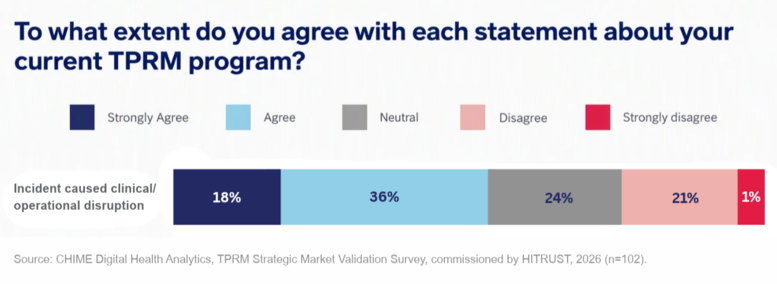
- New 3rd party research coming soon from HITRUST and CHIME* surveyed over 100 qualified TPRM leaders and found that vendor incidents had already caused clinical or operational disruption for approximately 22% of respondents.
What TPRM Leaders Can Do
- Map critical business processes to the vendors and shared service providers that support them into a portfolio for enhanced visibility.
- Analyze concentration by provider, platform, service category, and geography across the portfolio.
- Include downstream providers when evaluating concentration and continuity exposure.
- Define contingency, substitution, and exit plans for dependencies that exceed the organization’s practical tolerance.
Concentration risk is often created gradually, one reasonable vendor decision at a time. Managing it requires a portfolio view that shows where several acceptable relationships combine into one unacceptable dependency
Coming Up in the Next Blog in the Series
If you missed the first blog in the series, please check out it here. Be sure to follow HITRUST on LinkedIn and X to know when the next blog in the TPRM Top 10 series, Unreliable Vendor Data Undermines Risk Decisions, is posted.
*CHIME Digital Health Analytics. Third-Party Risk Management Assurance: Strategic Market Validation Survey. Commissioned by HITRUST. Ann Arbor, MI: College of Healthcare Information Management Executives, Digital Health Analytics 2026. In July 2026, HITRUST commissioned CHIME Digital Health Analytics to conduct a blinded market-validation survey of 102 qualified respondents from separate healthcare provider organizations with more than $1 billion in annual revenue. Respondents represented security and GRC leadership, TPRM ownership, procurement and vendor management, legal and contracting, and executive leadership. Every participating organization actively managed at least 200 third-party vendors, and 87% managed more than 500.