

Inconsistent scoring and reporting methods make it difficult to compare assurance reports and results across vendors.
Why It Matters
TPRM teams receive multiple forms of evidence to evaluate: Questionnaires, SOC 2 reports, HITRUST certification reports, penetration test results, vulnerability scans, and much more. Each artifact answers different questions and may use a different scope, testing method, treatment of exceptions, and reporting format. Reviewers must normalize the evidence before they can compare vendors or explain why one finding matters more than another.
That work depends heavily on analyst experience and repeated interpretation. Two vendors can appear to provide similar assurance while covering different systems or controls. The same weakness can be described in different terms or reported at a different level of detail. Comparison becomes a manual judgment exercise rather than a repeatable program capability.
What the Evidence Shows
New 3rd party research coming soon from HITRUST and CHIME* surveyed over 100 qualified TPRM leaders and found that:
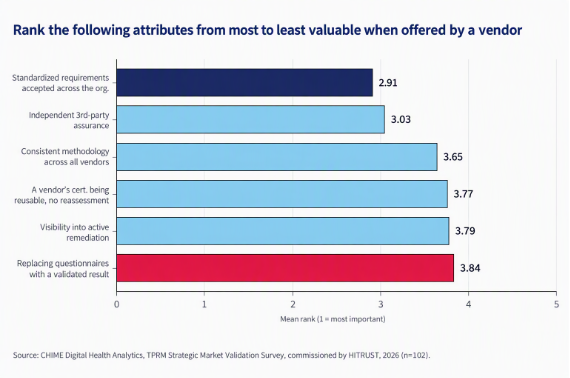
- Standardized requirements accepted across the organization and independent third-party assurance were the two most-valued attributes in the future-state model.
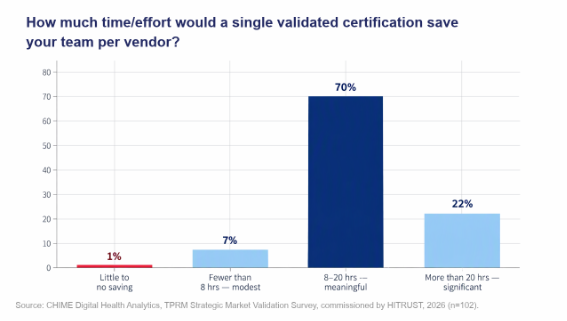
- 92% of respondents estimated that relying on a single validated certification could save at least eight hours per vendor assessment. An organization assessing 100 vendors per year could save 800 hours, or 100 business days, by utilizing this strategy.
What TPRM Leaders Can Do
- Define a consistent baseline for scope, control coverage, testing, and exception reporting across assurance mechanisms.
- Use common criteria to evaluate the relevance and severity of findings, regardless of the format in which they arrive.
- Increase reliance on standardized, independently validated evidence that can be reused across vendor relationships.
- Reserve supplemental requests for material gaps in coverage instead of repeating evidence already validated.
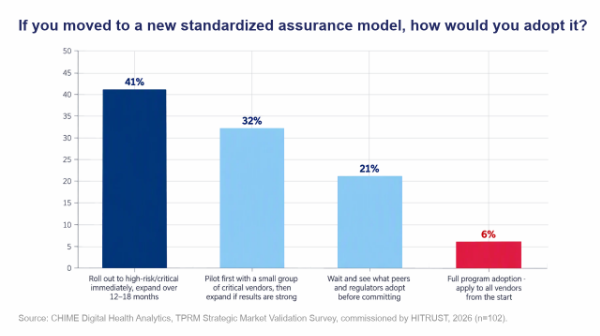
Requiring a single standardized certification can provide tremendous benefit to TPRM programs, both in reducing risk and increasing efficiency. Standardized independent validation can provide a more comparable baseline across a TPRM program’s vendors. When moving to adopt a standardized assurance model, the CHIME survey reported mixed results with how TPRM leaders would approach the process. Most programs (41%) would roll it out to high-risk vendors immediately and then expand to other vendors over the next year, while others (32%) would prefer to pilot first with a smaller group of those critical vendors.
The goal is not to conduct the same exhaustive assessment for every vendor, but to produce enough trustworthy information to identify material exposures early and direct limited expertise toward the risks capable of causing the greatest business impact.
Coming Up in the Next Blog in the Series
If you missed the first blog in the series, please check out it here. Be sure to follow HITRUST on Linkedin and X to know when the next blog in the TPRM Top 10 series, Manual Work Is Consuming TPRM Capacity, is posted.
*CHIME Digital Health Analytics. Third-Party Risk Management Assurance: Strategic Market Validation Survey. Commissioned by HITRUST. Ann Arbor, MI: College of Healthcare Information Management Executives, Digital Health Analytics 2026. In July 2026, HITRUST commissioned CHIME Digital Health Analytics to conduct a blinded market-validation survey of 102 qualified respondents from separate healthcare provider organizations with more than $1 billion in annual revenue. Respondents represented security and GRC leadership, TPRM ownership, procurement and vendor management, legal and contracting, and executive leadership. Every participating organization actively managed at least 200 third-party vendors, and 87% managed more than 500.