

Without timely reassessment, material changes in a vendor’s security posture can go undetected between formal reviews.
Why It Matters
Most assurance mechanisms provide a point-in-time view even when vendor environments continue to change after approval. Services expand, systems change, new downstream providers are introduced, and security incidents alter the risk profile. A review that was reasonable at onboarding might lose relevance before the next scheduled assessment.
“Modern businesses rely heavily on third-party partnerships to create value and drive innovation, but they are expanding faster than organizations can manage the risks. According to KPMG research, 83 percent of executives plan to expand their partner networks in the next one to three years, yet 71 percent admit that they have trouble getting their partners to align on goals.” - KPMG 2026 Global Third-Party Risk Management Survey
Limited monitoring also weakens the organization’s response to risk already accepted. A vendor approved with conditions may require enhanced oversight, time-bound remediation, or reassessment when a material event occurs. Without reliable triggers, the exception remains open while the business continues to depend on the service.
What the Evidence Shows
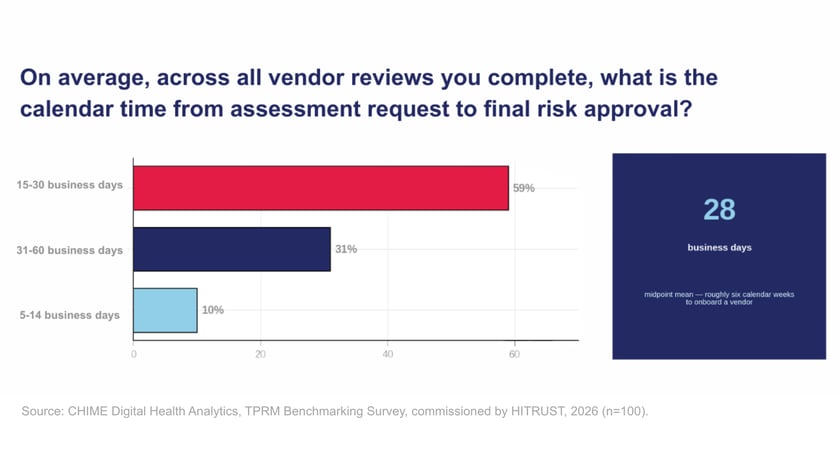
- New 3rd party research coming soon from HITRUST and CHIME* surveyed over 100 qualified TPRM leaders and found that the vendor approval process took a median of 28 days with almost 1/3 taking 31-60 days to complete.
- The Mitratech 2025 Third-Party Risk Management Study reported that only 29% of organizations could assess risk across the full vendor lifecycle, and that organizations actively monitored only 40% of their vendors on average.
What TPRM Leaders Can Do
- Set monitoring depth and reassessment frequency according to vendor risk and operational criticality.
- Trigger reassessment when service scope, system access, data handling, control ownership, or downstream dependencies materially change.
- Connect incident intelligence, remediation status, and monitoring data to the original approval decision.
- Apply enhanced monitoring and clear escalation paths to vendors operating under approved exceptions.
Continuous oversight does not require the same intensity for every vendor. It requires enough risk-based monitoring to recognize when the facts behind an earlier decision have changed.
Coming Up in the Next Blog in the Series
If you missed the first blog in the series, please check out it here. Be sure to follow HITRUST on LinkedIn and X to know when the last blog in the TPRM Top 10 series, Closing Perspective on The TPRM Top 10, is posted.
*CHIME Digital Health Analytics. Third-Party Risk Management Assurance: Strategic Market Validation Survey. Commissioned by HITRUST. College of Healthcare Information Management Executives, Digital Health Analytics 2026. Survey of 100 third-party risk management practitioners at U.S. healthcare provider organizations with annual revenue of $1 billion or more, fielded August 2026.